
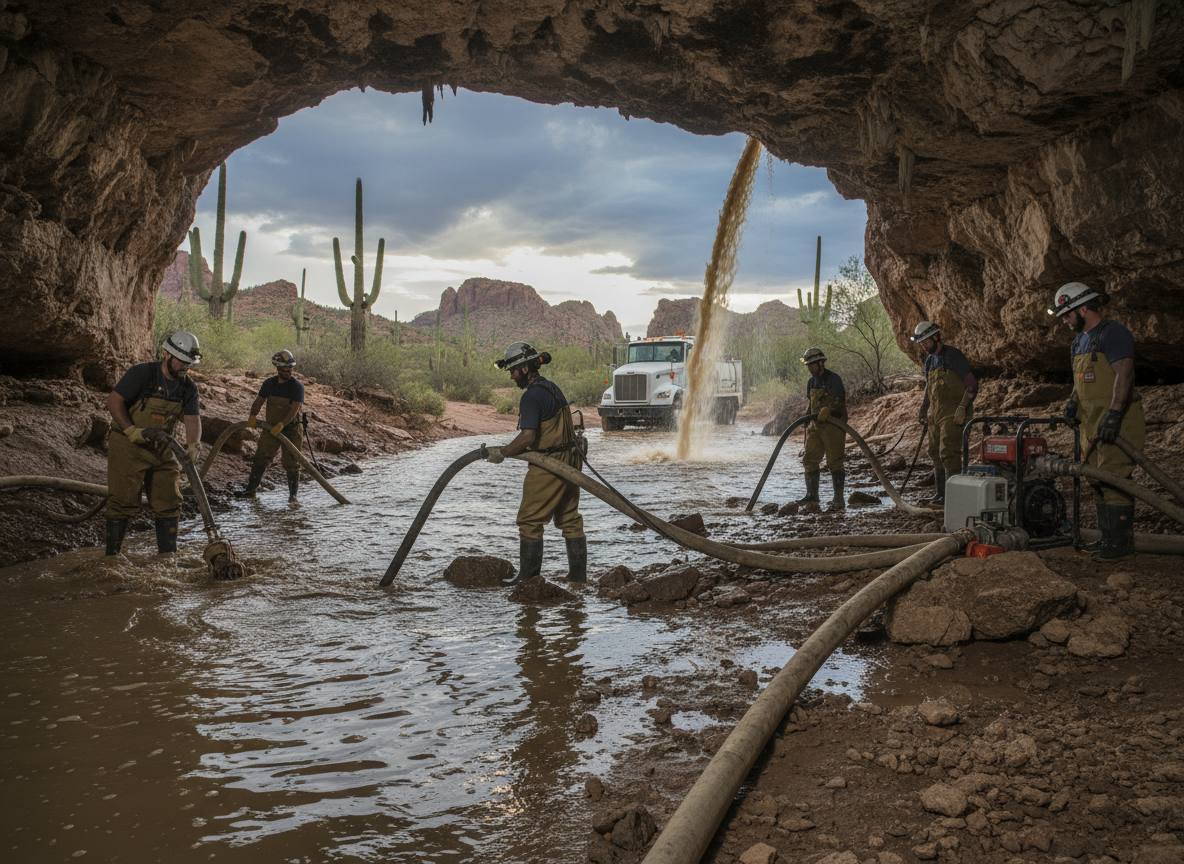
Lone Mountain sits on the eastern edge of Cave Creek with homes on large desert lots along E Lone Mountain Rd and side streets that climb into the foothills. Monsoon storms dump water fast onto the rocky ground, sending runoff into driveways and crawl spaces of ranch-style houses built from the 1980s onward. Cave Creek Restoration Solutions responds from 6130 E Cave Creek Rd with pumps and extraction equipment sized for these properties.
Access often means navigating steep gravel drives and tight turns between saguaros, so crews bring portable units that fit where larger trucks cannot. Nearby washes that feed toward Cave Creek Regional Park can back up during heavy rain, pushing water under slabs and into garages. The team works through Mon–Fri 8am–6pm and Sat 9am–2pm to pull standing water before it reaches framing or drywall.
Because the neighborhood sits in Maricopa County’s Sonoran Desert climate, summer heat speeds evaporation while winter rains linger in shaded low spots. Extraction here focuses on removing both surface water and the moisture trapped in desert soil so secondary mold does not form under tile or in wall cavities.
Around Lone Mountain
We regularly work near:
- 📍E Lone Mountain Rd
- 📍Cave Creek Regional Park
- 📍Black Mountain Trailhead
- 📍N 48th St
Water Extraction & Removal in Lone Mountain — Local Notes
- •Rocky Sonoran soil around Lone Mountain slows gravity drainage, so crews use high-volume pumps and air movers longer than in flatter neighborhoods.
- •Many homes sit on septic systems with leach fields that flood during monsoons, requiring careful extraction to avoid contaminating yards.
- •Steep lots off E Lone Mountain Rd limit truck access, so portable extractors and hoses staged from the street are standard.
- •Older ranch houses often have post-tension slabs with limited crawl-space access, making moisture mapping essential before drying begins.