
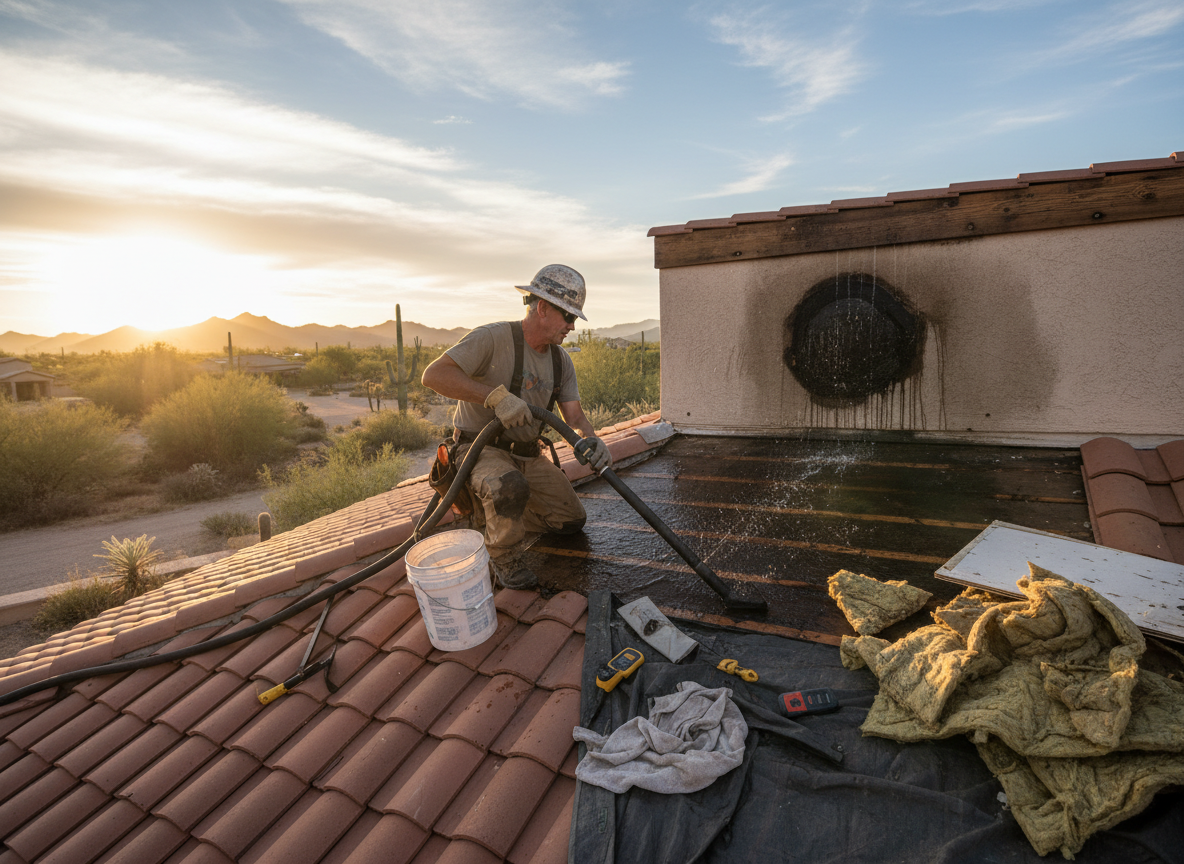
Cave Creek homes built before the 1990s often feature clay tile roofs over plywood decking that can crack or shift after decades of intense summer heat followed by sudden monsoon downpours. Water travels along rafters and pools in insulation or behind stucco walls, especially in Desert Hills properties where slopes direct runoff toward foundations near Spur Cross Ranch Conservation Area. Technicians must map moisture with infrared cameras before opening ceilings because trapped water in these older builds quickly leads to hidden mold in the dry climate once humidity spikes.
Maricopa County building codes require permits for structural repairs when decking or load-bearing members are compromised, so restoration crews coordinate with local inspectors on jobs in Carefree Foothills and Downtown Cave Creek. Extraction focuses on removing water from attic spaces without disturbing active wildlife corridors around Cave Creek Regional Park. Dehumidification equipment runs longer here than in coastal regions because low ambient humidity masks remaining moisture in adobe or thick plaster walls common to the area.
Homeowners in Scottsdale-adjacent neighborhoods frequently discover leaks only after water stains appear on interior drywall because the arid Sonoran Desert climate allows slow evaporation that hides the problem until the next rain event. Restoration includes removing saturated insulation and treating affected wood to prevent warping in the extreme temperature swings between day and night. Work is scheduled around business hours at 6130 E Cave Creek Rd to minimize disruption in residential zones.
Technician insight
In Cave Creek the thing that catches most people out with roof leak water damage restoration is how monsoon rains hit older clay tile roofs on Desert Hills homes built on slopes; water follows the rafters for twenty feet before showing up inside, so you end up chasing moisture through multiple rooms instead of just patching one spot near the ridge.
Monsoon Leak in Carefree Foothills
Water entered through cracked tiles on a 1980s home and traveled along rafters into the master bedroom ceiling. Infrared scans revealed saturation extending into two closets. Extraction and targeted drying prevented mold spread, and repairs were completed before the next storm system arrived.
Roof Leak Water Damage Restoration Services We Offer
✓Tile Roof Leak Detection
Infrared scanning and moisture mapping of clay tile roofs common on older Cave Creek homes to locate entry points before monsoon season escalates damage.
✓Attic Water Extraction
Removal of standing water and saturated insulation from attics where roof leaks pool above living spaces in Desert Hills and Carefree Foothills properties.
✓Ceiling and Drywall Restoration
Controlled demolition and replacement of water-damaged drywall and ceilings while preserving original plaster finishes found in Downtown Cave Creek homes.
✓Structural Drying and Dehumidification
Industrial drying of rafters, decking, and wall cavities using equipment sized for the low-humidity Sonoran Desert air to prevent secondary mold growth.
✓Mold Prevention After Roof Leaks
Antimicrobial treatment and ventilation adjustments tailored to Maricopa County homes where rapid drying after monsoon rains is critical to stop spore activation.
Roof Leak Water Damage Restoration Cost in Cave Creek, AZ
| Service | Typical Range | What Affects It |
|---|---|---|
| Initial Assessment and Moisture Mapping | $150–$300 | Includes thermal imaging; higher for multi-story or difficult-access homes in Carefree Foothills. |
| Attic Water Extraction | $400–$900 | Varies by volume of water and amount of insulation removal needed. |
| Full Structural Drying Package | $600–$1,400 | Daily equipment rental and monitoring until dry; longer runs common after monsoon events. |
| Drywall and Insulation Replacement | $800–$2,200 | Depends on linear feet of ceiling and wall affected plus permit fees in Maricopa County. |
Ranges are typical for Cave Creek, AZ and confirmed with an exact written quote before any work starts.
How it works
- 1
On-Site Assessment
Technicians inspect the roof, attic, and affected interiors using moisture meters and thermal imaging to trace water paths through typical Cave Creek construction.
- 2
Water Extraction
Standing water is removed from attics and wall cavities with portable pumps and vacuums suited to the sloped terrain around Spur Cross Ranch Conservation Area.
- 3
Drying and Monitoring
Equipment runs continuously with daily moisture checks until readings match the dry Sonoran Desert baseline, avoiding over-drying that can crack older wood.
- 4
Repairs and Final Walkthrough
Rebuild of damaged sections occurs after county inspection sign-off, followed by a walkthrough with the homeowner at the Cave Creek address.
Pricing
Upfront quotes after inspection; final cost depends on square footage affected, roof access difficulty, and whether structural decking replacement is required.