
2026-08-26 · Thomas Brown
Removing Standing Water From Cave Creek Garages And Driveways
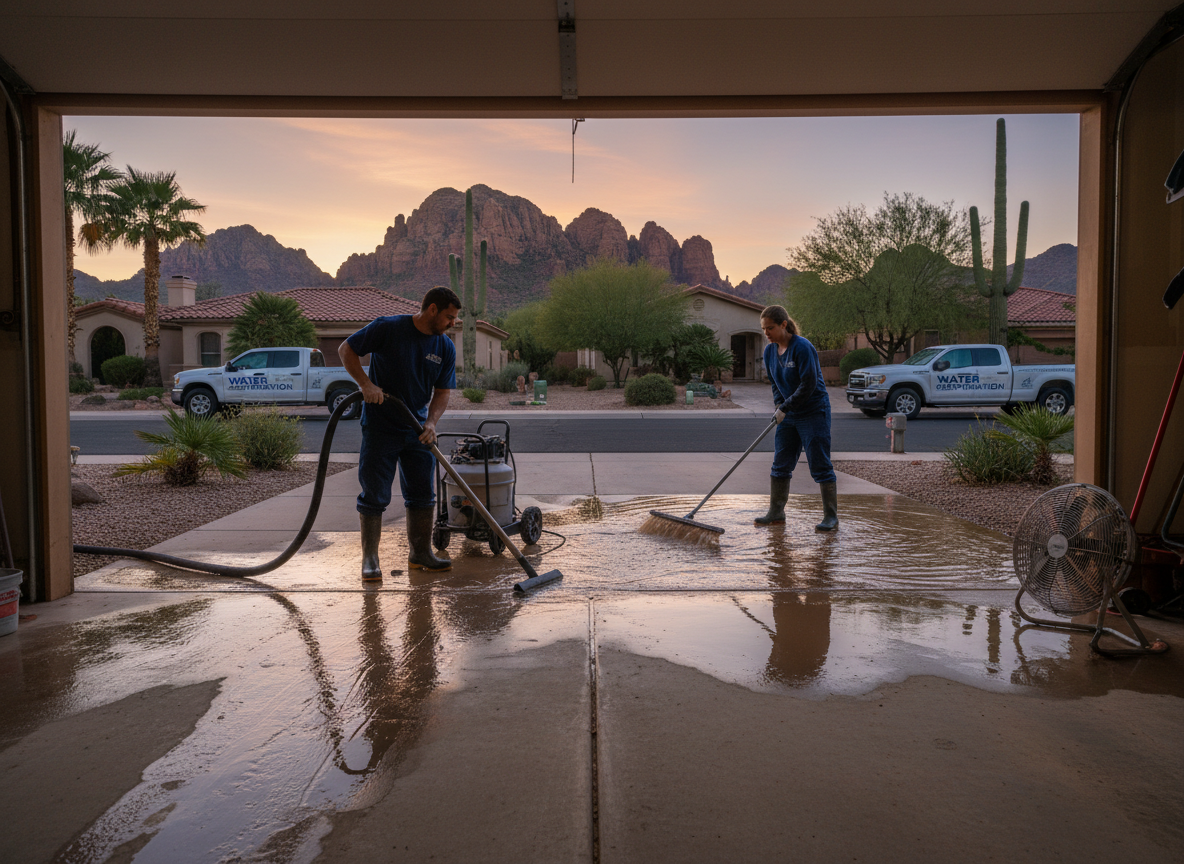
Standing water in Cave Creek garages and driveways clears fastest when crews begin with submersible pumps rated for 50–100 gallons per minute followed by moisture meters to confirm dryness below the slab. This approach accounts for the Sonoran Desert climate where sudden downpours send water across rocky soil that drains poorly on flat or low-lying lots.
Local Drainage Realities in Cave Creek Neighborhoods
Driveways in Downtown Cave Creek and Desert Hills often sit at the base of natural washes that channel runoff from higher elevations near Cave Creek Regional Park. The gravelly desert soil absorbs little during heavy events, so water pools against garage thresholds and seeps under doors. In Carefree Foothills, steeper grades help some properties shed water quickly but create fast-moving sheets that carry sediment onto concrete surfaces. Maricopa County properties near Scottsdale experience similar patterns when storms track north from the valley floor. These conditions mean extraction crews must account for both surface volume and hidden moisture trapped against stucco walls or beneath pavers.
Equipment and Sequence for Water Extraction & Removal
Start by isolating the area with containment barriers to keep sediment from washing into landscaping around Spur Cross Ranch Conservation Area homes. Technicians then deploy truck-mounted extractors to pull bulk water, followed by air movers positioned at 45-degree angles to push remaining moisture out of expansion joints. In garages with epoxy coatings, crews check for delamination where water has wicked under the finish. This sequence prevents the alkali staining common on local concrete exposed to repeated wetting and drying cycles. Homeowners in Rancho Manana or Rockaway Hills see faster results when extraction begins within hours of the rain stopping rather than waiting for evaporation alone.
Preventing Secondary Damage After Initial Removal
Once visible water is gone, residual moisture in slab joints can feed mold within 48 hours in the mild winter temperatures typical of the region. Direct readers to Preventing Secondary Issues After Water Extraction In Cave Creek for monitoring steps. Checking behind baseboards and under storage cabinets catches hidden pockets that surface drying misses. Properties near North Scottsdale often need additional dehumidification because lower humidity outside can mask ongoing evaporation from the slab. Linking extraction work to Water Extraction & Removal ensures consistent protocols across flood events.
When to Call for Flood Damage Cleanup Support
Persistent seepage after 24 hours usually signals a larger drainage issue tied to the lot grading or nearby washes. Crews familiar with Flood Damage Cleanup can map water paths across the property and recommend grading adjustments that reduce future pooling. Owners in Lone Mountain or Dove Valley Ranch benefit from this assessment because their homes sit on varied terrain where one driveway may drain well while the adjacent garage does not. Scheduling during business hours at 6130 E Cave Creek Rd allows same-day evaluation before moisture migrates into living spaces.